
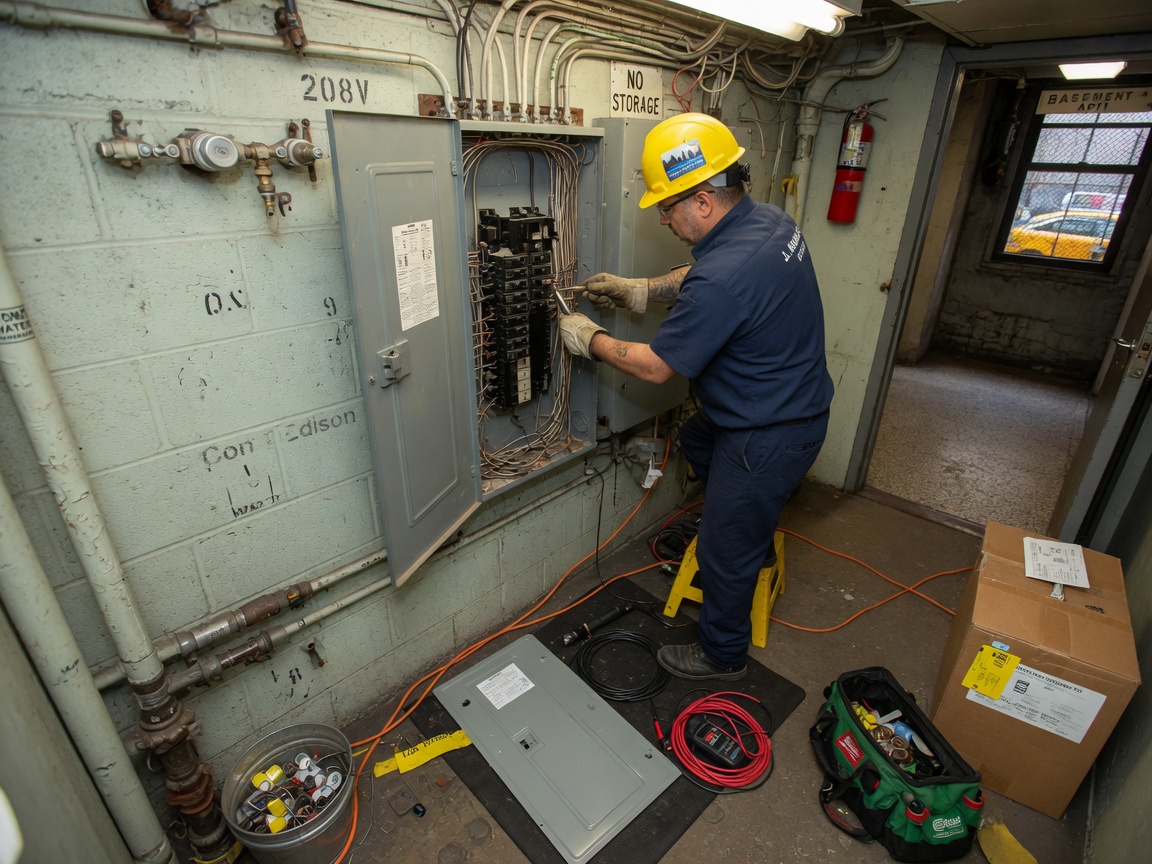
New York City buildings constructed before 1940 often retain fuse boxes or 60-amp panels that cannot support modern appliances, air conditioning units, and EV chargers. Upgrading requires evaluating knob-and-tube or cloth-insulated wiring still present in many Greenwich Village and Park Slope row houses. Technicians must coordinate with Con Edison for service entrance changes and pull permits under the NYC Electrical Code, which mandates GFCI and AFCI protection in updated panels. Failure to address aluminum branch wiring during the swap can leave hidden fire risks in walls.
Summer humidity and winter freeze-thaw cycles in the five boroughs accelerate corrosion on exterior meter stacks and main breakers. In basement installations common to Brooklyn brownstones, groundwater seepage near the panel location demands moisture-rated enclosures and proper bonding to the building steel. Upgrades in high-rises above the third floor frequently involve coordinating with building management for riser access and temporary power shutoffs that affect multiple units.
Electrical Panel Upgrade Near You — Choose Your City
Every city below has its own local Electrical Panel Upgrade page with coverage details.
Other areas
Nassau
Suffolk County
Erie County
Erie
Monroe County
Westchester
Suffolk
Westchester County
Onondaga
Albany
Monroe
Kings County
Bronx County
Richmond County
Albany County
Schenectady
Oneida
Rensselaer
Niagara County
Broome County
Dutchess County
Nassau County
Rockland
Saratoga County
Load calculations must account for the dense appliance use typical in NYC apartments where space heaters run alongside induction ranges. Panels rated below 150 amps routinely trip during peak winter mornings when electric heat and kitchen loads coincide. Proper upgrades include installing a main breaker with sufficient interrupting capacity for the utility feed and labeling every circuit for future service calls in tight utility closets.
Technician insight
In New York City, the thing that catches most people out with Electrical Panel Upgrade is discovering knob-and-tube wiring still feeding lights in pre-war Brooklyn and Manhattan buildings; you cannot simply swap the panel without addressing those circuits or the job fails inspection and leaves a fire hazard.
200 Amp Upgrade in a Park Slope Brownstone
Homeowner reported frequent breaker trips when running window AC units. Inspection revealed a 60-amp fuse box with cloth wiring in the basement. Crew replaced the service entrance, installed a 200-amp panel with AFCI breakers, and coordinated the Con Edison reconnect. The home now runs full summer loads without interruption.
Electrical Panel Upgrade Services We Offer
✓100 Amp to 200 Amp Upgrade
Replaces undersized service with a 200-amp panel to support added circuits for air conditioning and appliances common in NYC row houses.
✓Fuse Box to Breaker Conversion
Swaps outdated fuse panels for modern circuit breakers with AFCI and GFCI protection required by current NYC code in older Manhattan and Queens homes.
✓Residential Service Entrance Upgrade
Updates the meter base and main feeder from the street to the panel, addressing corrosion from sidewalk salt and aging Con Edison connections.
✓Subpanel Installation
Adds a secondary panel in garages or finished basements to separate high-draw loads without overloading the primary service in tight Brooklyn properties.
✓Aluminum Wiring Remediation
Identifies and corrects aluminum branch circuits during panel work to prevent overheating in pre-1970s buildings across the city.
Electrical Panel Upgrade Cost in New York
| Service | Typical Range | What Affects It |
|---|---|---|
| Standard 200 Amp Residential Upgrade | $2,200–$4,800 | Higher when knob-and-tube wiring must be replaced or panel is in a tight basement |
| Fuse Box Conversion | $1,800–$3,600 | Varies with number of circuits and whether new AFCI breakers are required |
| Subpanel Addition | $900–$2,100 | Depends on feeder length and whether trenching or conduit through masonry is needed |
Ranges are typical for New York and confirmed with an exact written quote before any work starts.
How it works
- 1
Site Assessment
Technician inspects the existing panel, service entrance, and wiring condition in the specific neighborhood building.
- 2
Load Calculation And Permit
Calculates required amperage and submits paperwork to the NYC Department of Buildings before any work begins.
- 3
Panel Replacement
Removes the old equipment, installs the new panel, and makes all connections while coordinating utility shutoff.
- 4
Testing And Labeling
Verifies every circuit, installs required protection devices, and labels the panel for the homeowner.
Pricing
Upfront quotes provided after on-site assessment of wiring condition and access.