
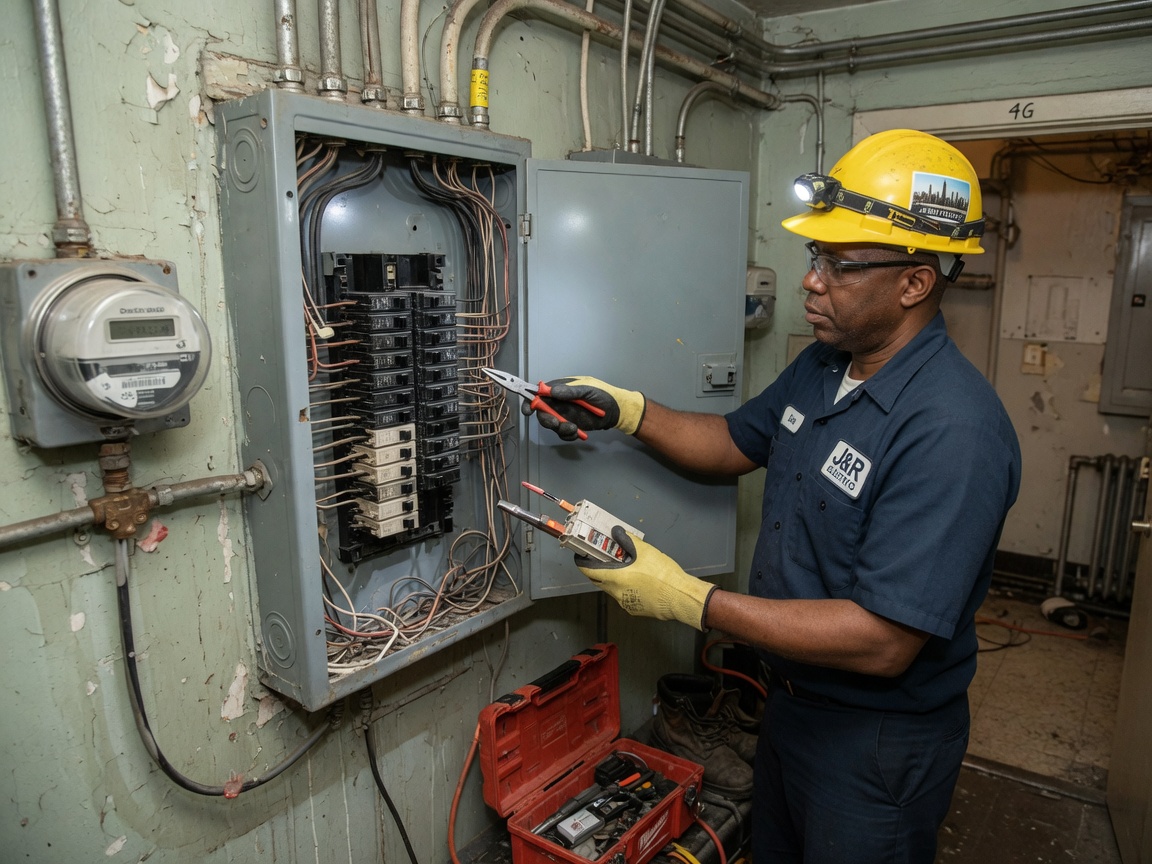
New York City buildings from the 1920s through 1960s frequently contain Federal Pacific or Zinsco panels that fail to trip under load. These panels sit behind plaster walls in brownstones and pre-war apartments, requiring careful removal of multiple layers of drywall and knob-and-tube remnants before any breaker work begins. Heat waves push window units and mini-splits past their circuits, causing repeated trips that mask deeper panel corrosion from decades of steam heat and salt air.
Technicians must verify aluminum wiring connections at every breaker because expansion cycles in unconditioned basements loosen terminations over time. Main breaker swaps in six-story walk-ups often involve coordinating with Con Edison for temporary service drops, since many buildings still share meters in the basement. Arc-fault and ground-fault breakers are now required on bedroom and bathroom circuits under current NYC Electrical Code, yet older panels lack the bus bars to accept them without a full replacement.
Circuit Breaker Repair Near You — Choose Your City
Every city below has its own local Circuit Breaker Repair page with coverage details.
Other areas
Nassau
Suffolk County
Erie County
Erie
Monroe County
Westchester
Suffolk
Westchester County
Onondaga
Albany
Monroe
Kings County
Bronx County
Richmond County
Albany County
Schenectady
Oneida
Rensselaer
Niagara County
Broome County
Dutchess County
Nassau County
Rockland
Saratoga County
Moisture from roof leaks and rising groundwater in low-lying areas of Queens and Brooklyn corrodes breaker stabs, creating high-resistance points that generate heat. Replacement requires matching the exact panel brand and series because aftermarket breakers often fail to seat properly on legacy bus bars. Every job ends with a torque check on all lugs and a thermal scan under load to catch hidden hot spots before the panel cover goes back on.
Technician insight
In New York City the thing that catches most people out with circuit breaker repair is the number of pre-1965 buildings still carrying Federal Pacific panels behind layers of plaster and lead paint; you cannot simply swap a breaker without first confirming the bus bar condition or you create a hidden fire hazard that only shows up during the next summer heat wave.
Tripped Main Breaker in Brooklyn Brownstone
A six-story building in Park Slope lost power to all units during a July heat wave. Inspection revealed a corroded main breaker in the shared basement panel installed in 1952. The breaker was replaced after utility coordination and bus bar cleaning; power was restored the same evening with no further trips.
Circuit Breaker Repair Services We Offer
✓Single Breaker Replacement
Replace individual tripped or worn breakers in existing panels serving Manhattan apartments and Brooklyn brownstones.
✓Main Breaker Repair
Address failing main breakers that cut power to entire buildings, common in pre-war six-story walk-ups across New York City.
✓Arc Fault Breaker Installation
Upgrade circuits to AFCI protection in bedrooms and living areas to meet current NYC code requirements.
✓GFCI Breaker Replacement
Install or repair GFCI breakers on bathroom, kitchen, and outdoor circuits exposed to moisture in older city housing stock.
✓Overloaded Circuit Diagnosis
Trace repeated trips caused by added window AC units and modern appliances in dense New York City apartments.
Circuit Breaker Repair Cost in New York
| Service | Typical Range | What Affects It |
|---|---|---|
| Single breaker replacement | $175–$350 | Higher in tight basement or shared-meter locations common in older buildings |
| Main breaker replacement | $450–$850 | Increases with utility coordination and multi-story access |
| AFCI or GFCI breaker install | $225–$400 | Depends on panel compatibility and number of circuits |
Ranges are typical for New York and confirmed with an exact written quote before any work starts.
How it works
- 1
Initial Assessment
Arrive on site and review panel condition, wiring type, and load history specific to the building age and neighborhood.
- 2
Power Isolation
Coordinate with utility if needed, then isolate the panel and verify zero energy before any cover removal.
- 3
Component Replacement
Remove faulty breaker, inspect bus bars for damage, and install correct replacement matched to the existing panel.
- 4
Testing and Restoration
Torque all connections, perform thermal imaging under load, and restore power with documented results.
Pricing
Upfront quotes provided before any work begins; final price depends on panel access and parts required.